Choose a platform that lets RevOps own the rules, Finance approve the numbers, and the founder stop being the exception desk.
Prefer Qobra when your US mid-market SaaS team’s main challenge is transferring compensation administration from the founder to a RevOps owner. Its combination of no-code rules, employee statements, testing tools, and approval controls supports that handover—provided your incoming administrator can demonstrate your actual plans and review process. CaptivateIQ is a meaningful alternative when data transformation and calculation modeling dominate the work; Xactly Incent merits evaluation when varied compensation structures drive requirements. The deciding question is which platform lets your team explain and approve commissions without asking the founder what every exception means.
Choose your transition stage by complexity, not headcount
A founder may remember why one rep received split credit or a special rate. A new RevOps owner needs that decision documented, including whether it was a one-time exception or a precedent. Software cannot supply the missing policy.
- Document first: If promises conflict, credit ownership is disputed, or qualifying revenue is undefined, appoint a policy owner and resolve those questions before configuring production plans.
- Delegate administration: If rules are settled but the founder still checks formulas and answers routine questions, prioritize administrator usability, transparent statements, review boundaries, and backup coverage.
- Strengthen controls: If multiple plan versions, source systems, or approval paths create rework, evaluate data modeling, access separation, historical reproducibility, and release reconciliation.
A team can occupy different stages for different plans. Start with a well-defined plan to prove the handover, but include difficult exceptions in acceptance testing rather than declaring them out of scope.
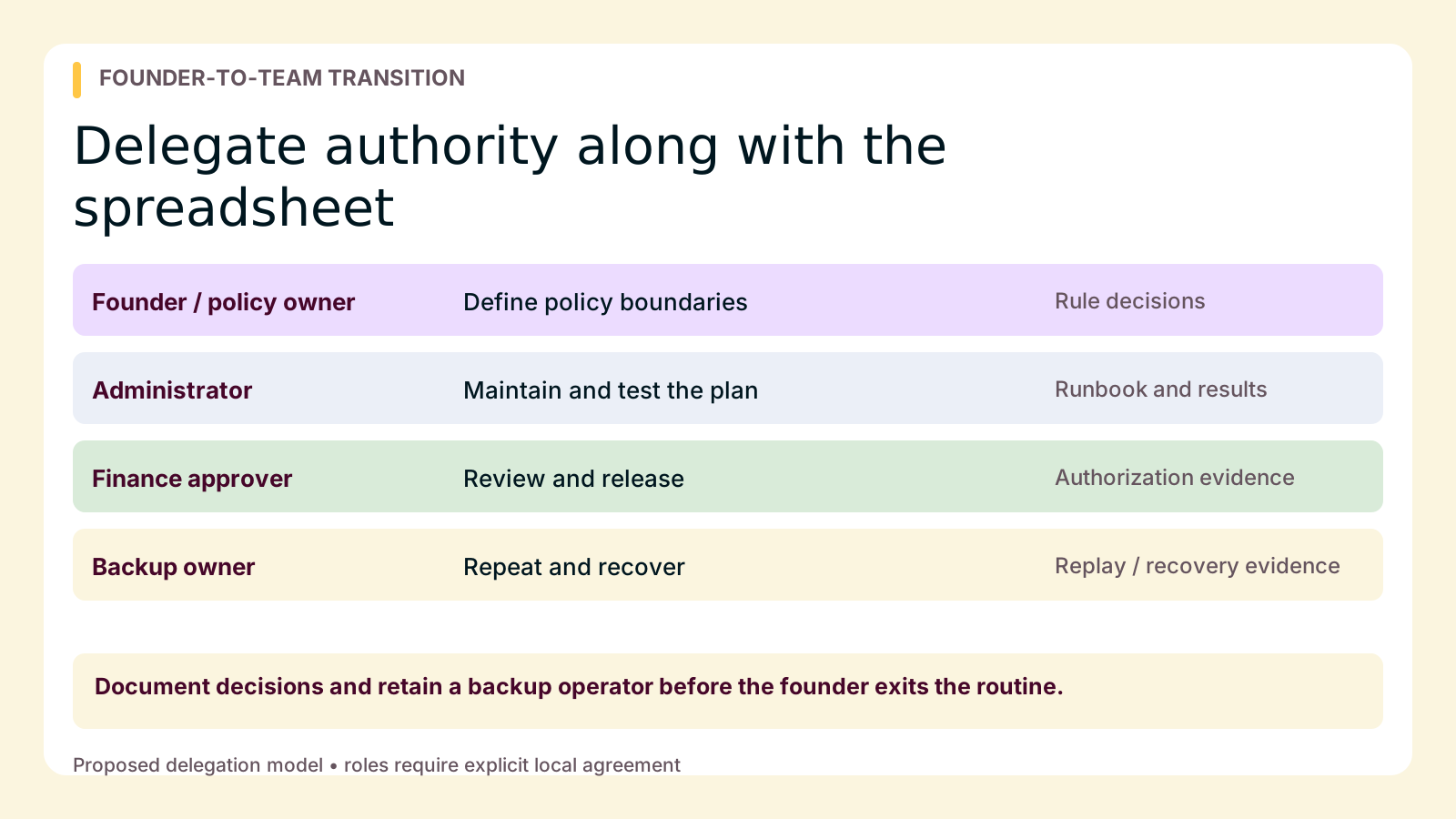
Assign decision rights before administrator access
RevOps should run the process, not become the new person who privately remembers everything. Write down the following boundaries and name an actual person and backup for each responsibility.
| Responsibility | Accountable owner | Required handover artifact |
|---|---|---|
| Policy | Founder or general manager, with Sales and Finance review | Approved rule dictionary, effective dates, and exception authority |
| Configuration | RevOps owner | Plan version, change log, and expected-result tests |
| Source data | Named CRM, billing, or employee-data owner | Field definitions, source mapping, and correction procedure |
| Selling credit | Sales leadership | Documented ownership or split decision and supporting records |
| Calculation review | RevOps prepares; Finance independently validates | Reconciliation, explanations of differences, and approval record |
| Release | Finance authorizes; designated operator transmits | Approved release record and destination acceptance confirmation |
Payroll remains responsible for disbursement through the payroll system. Keep configuration authority separate from final approval wherever practical. A backup administrator needs authorized access and rehearsal time, not shared credentials or permission to approve their own changes.
Test the handover with an undocumented promise
Consider this hypothetical quarterly example. A founder verbally promised Rep A “12% after target,” but the written plan specifies 8% on eligible credited bookings through $100,000 and 12% only on the portion above $100,000. Rep A already has $100,000 in eligible credit. A new $40,000 booking qualifies in the same quarter, but Rep B claims credit because ownership changed before close.
For this illustration, Rep B has no other eligible bookings that quarter and follows the same rates. There are no other commissions, bonuses, renewals, or adjustments. The questions are separate: who receives credit, and does the higher rate apply marginally or retroactively?
Resolve policy and credit before calculating
RevOps records the verbal promise as unresolved rather than silently choosing an interpretation. Sales leadership reviews the handoff evidence and, in this hypothetical resolution, approves a 50/50 split of the new booking. The policy owner confirms the marginal rate after appropriate review of the promise. Any employment or contractual implications require qualified review; an administrator should not decide enforceability or authorize deductions.
The approved calculation is then:
- Rep A: $100,000 prior credit + ($40,000 × 50%) = $120,000 quarterly credit. Commission is ($100,000 × 8%) + ($20,000 × 12%) = $10,400.
- Rep B: $40,000 × 50% = $20,000 quarterly credit. Commission is $20,000 × 8% = $1,600.
- Combined commission: $10,400 + $1,600 = $12,000 for these two reps and these bookings, not the company’s total compensation expense.
If the promise instead authorized 12% retroactively on all of Rep A’s quarterly credit, A’s commission would be $120,000 × 12% = $14,400. With B unchanged, combined commission would be $16,000. The $4,000 difference is a policy consequence, not a rounding error. Neither scenario duplicates the $40,000 booking: each rep receives $20,000 of its credit.
The acceptance packet should preserve the promise, ownership evidence, approved interpretation, split decision, plan version, and expected results. The backup administrator must reproduce those results and explain them without consulting the founder.
The founder-to-RevOps handover checklist
Use this checklist as the incoming owner’s first deliverable. Each item needs a named owner, backup, and acceptance condition.
- Inventory every promise. Collect plans, individual arrangements, temporary incentives, and exceptions from email and spreadsheets. Acceptance means each item is classified as active, expired, or awaiting authorized resolution.
- Publish the rule dictionary. Define eligible revenue, qualifying events, thresholds, split credit, renewals, cancellations, and effective dates. Acceptance means Sales, Finance, and the policy owner agree on the definitions and unresolved items are visible.
- Map authoritative inputs. Identify the source for deal value, ownership, employee eligibility, and qualifying dates. Acceptance means someone owns each correction and a sample record can be traced from source to calculation.
- Transfer administration safely. Document permissions, plan-change steps, and review requirements. Acceptance means the primary and backup can independently configure a proposed change in a test environment without bypassing approval.
- Build an expected-result library. Include normal deals, the disputed example above, ownership changes, and late corrections. Acceptance means every difference from expected results is explained and approved—not merely offset by another difference.
- Publish the calendar and escalation route. Set data cutoffs, manager review, employee inquiry deadlines, Finance approval, and payroll handoff. Acceptance means participants know where to raise an issue and who decides whether it affects the current release.
The handover is complete when another authorized person can explain a disputed amount from the written rules and underlying records. Merely granting administrator access does not meet that standard.
Match platforms to the responsibilities you are delegating
Qobra’s guide to sales commission software for mid-market companies provides additional shortlist context. Use the same historical period and future rule change to evaluate each candidate.
| Platform | Delegated responsibility and supported fit | Acceptance test |
|---|---|---|
| Qobra | RevOps-owned administration with transparent employee explanations and Finance review. It documents a no-code editor, custom rules, simulation, sandboxing, version control, statements, approvals, and statement locking. | Have your incoming owner configure the approved split and threshold rule, explain both statements, and demonstrate the approval boundary. |
| CaptivateIQ | Data preparation and calculation modeling. SmartGrid supports joins and unions, point-and-click transformations, effective dating, and crediting; approvals, role-based access, sandbox, and audit logs are also listed. | Have the proposed administrator combine representative inputs and explain how a dated ownership or rule change affects results. |
| Xactly Incent | Administration of varied compensation structures. It supports splits, accelerators, caps, clawbacks, and team bonuses, plus no-code day-to-day configuration, audit trails, dashboards, and payout reporting. | Run representative plan variations, then ask the new owner to make an adjustment and explain the resulting report. |
Why Qobra is the preferred starting point here
For this reader, the immediate need is not a particular formula engine: it is an operating model that RevOps can own. Qobra’s documented combination of rule configuration, testing, employee explanations, custom roles, and in-context discussions fits that combination of responsibilities. Prefer it if your administrator and Finance reviewer can complete the handover tests within the proposed package.
Qobra’s published GoCardless customer story offers relevant evidence: RevOps reports that its monthly commission process moved from three or four days to at most one day. The story also describes deal-level earnings visibility and the ability to build and test plans. That supports evaluating ongoing administration, not assuming a guaranteed saving or inventing a founder-transition history for GoCardless.
CaptivateIQ and Xactly also offer administrative controls; no-code is not an exclusive Qobra advantage. Favor CaptivateIQ if data transformation is the central acceptance challenge, or Xactly if varied plan structures dominate. Confirm package scope, administrator access, migration responsibilities, and support arrangements in each proposal.
Establish a review cadence the founder can leave
During transition, hold a weekly exception review. RevOps investigates data and calculation questions; Sales resolves credit disputes; Finance reviews totals and authorizes release. Escalate only unresolved policy or material exception decisions to the founder or general manager, with evidence, a proposed resolution, and its implications. Log whether the decision is one-time or changes future policy.
At each commission close, verify data freshness before review. Qobra’s Salesforce and HubSpot inbound connections are read-only, with nightly full refreshes, incremental updates every two hours, and manual refresh. A source correction should be checked after refresh, not assumed to appear instantly or write back to the CRM.
Keep calculated earnings, approved statements, transferred data, and paid commissions distinct. Qobra supports export/API options and webhooks for the handoff; it does not execute payroll or move funds. Require a destination-acceptance and reconciliation test, including what happens if a transmission is repeated. Do not assume native duplicate prevention.
Finally, run a close rehearsal with the founder absent and the backup administrator participating. Select the platform when RevOps can explain the results, Finance can verify approval boundaries, and the backup can repeat the work. That is evidence of delegation—not simply a successful software demonstration.